
What Is Amazon PPC? How the Auction Decides Who Wins

Amazon PPC is pay-per-click advertising inside Amazon's store. You bid for placements, you pay only when someone clicks, and you compete across four formats: Sponsored Products, Sponsored Brands, Sponsored Display, and Streaming TV.
What a click costs you depends on an auction Amazon has long described as a generalized second-price auction, where the winner pays just enough to beat the next-ranked bidder.
On August 31, 2026, the Federal Trade Commission and 22 state attorneys general sued Amazon in the Western District of Washington, alleging that since 2019 an undisclosed surcharge made advertisers pay substantially more than that auction would produce. Amazon disputes the allegations and says advertisers never pay more than their maximum bid.
The practical conclusion holds either way. Set every bid at the number you are willing to pay in full, because by the FTC's own figures Sponsored Products advertisers paid their own winning bid close to 80% of the time in 2024.
WHAT AMAZON PPC COVERS IN 2026
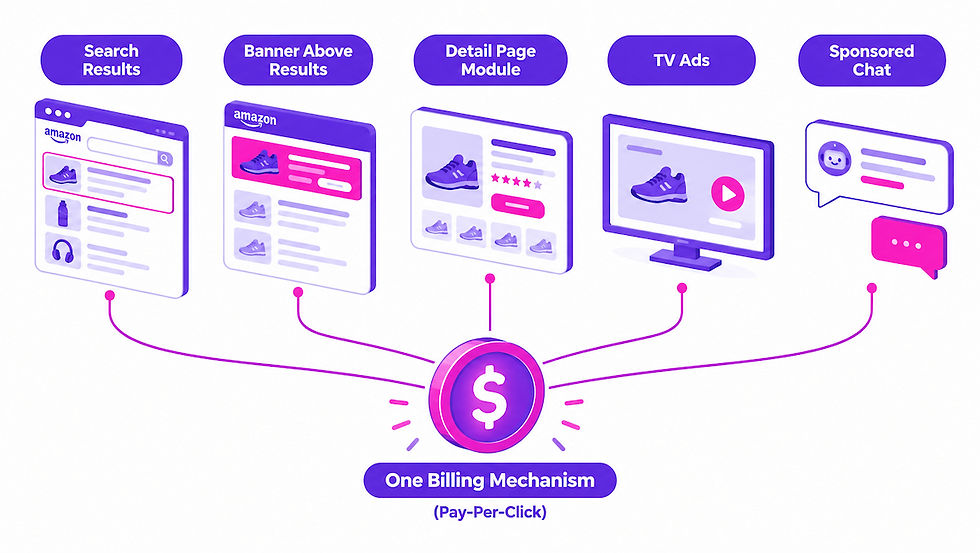
Amazon PPC spans four ad formats, and they do different jobs at different points in a
shopper's decision. Sponsored Products promotes individual listings in search results and on product detail pages. Sponsored Brands places your logo, a headline, and a product set above search results, and Sponsored Display follows shoppers with product and audience targeting both on and off Amazon.
Streaming TV, which Amazon renamed from Sponsored TV in 2025, puts video in front of
audiences on Prime Video, Freevee, and Fire TV. A fifth surface arrived in March 2026, when Sponsored Products and Sponsored Brands prompts moved out of beta and became billable inside Alexa for Shopping conversations.
All five bill the same way. You set a maximum bid, the auction decides whether your ad shows, and you are charged only when a shopper clicks. Nothing charges on impressions.
HOW A SECOND-PRICE AUCTION IS SUPPOSED TO WORK
In a generalized second-price auction, the highest-ranked bidder wins the placement but pays only enough to beat the bidder ranked below them. Bid $2.00 against a next-best bid of $1.20, and you pay $1.21. Your maximum functions as a ceiling you rarely touch.
Rank is not bid alone. Amazon combines your bid with how relevant and how likely to convert your listing appears for that query, which is why a cheaper bid on a stronger listing can outrank an expensive bid on a weak one. The system rewards listings that convert, because Amazon earns on the sale as well as the click.
That design is why the standard advice has always been to bid your true maximum value. If you only ever pay one cent above the next bidder, an aggressive ceiling costs you nothing and wins you more auctions. Every primer on the subject, including ones we have written, has taught it that way.
WHAT THE FTC SAYS HAPPENS INSTEAD

The FTC's complaint alleges that beginning in 2019 Amazon changed its auction rules without notice, adding a surcharge it internally called a "soft reserve price." The agency says the result was that advertisers paid substantially more than a generalized second-price auction would produce, across more than seven years, affecting over one million brands and sellers.
The internal language quoted in the complaint is specific. Amazon staff described a price that "isn't set by an actual bidder" but a "proxy 2nd price that we calculate," referred to an "invented auction participant," and called the approach a "clever non-transparent way to charge first price." One passage acknowledges that advertisers "are operating under the assumption that Amazon uses a GSP auction."
The trend line matters more than any single quote. The FTC states that the share of auctions where Sponsored Products advertisers paid their own full bid rose from 30% to 40% in 2021, to 70% in 2022, and to roughly 80% by 2024. If that is accurate, the ceiling stopped being a ceiling somewhere around 2022.
Amazon rejects the characterization. It says the FTC "fundamentally misunderstands how advertisers operate," acknowledges using soft reserve prices while arguing they set the market value of a placement and are standard in digital advertising, and points out that advertisers never pay above their stated maximum.
It cites average winning bids for Sponsored Products search ads falling 50% between 2019 and 2025. The case is unresolved, and nothing here is a finding of fact.
READ AMAZON'S OWN DOCUMENTATION ON THIS. THERE IS NOTHING THERE.
Amazon's public guide to dynamic bidding explains how bids adjust for conversion likelihood. It never explains how an auction is won or what an advertiser pays per click.
We went looking for the Tier 1 answer while researching this piece and could not find one. For a mechanism that sets the price on billions of dollars of spend, the absence is its own data point, and it is the reason the FTC allegation landed as news rather than confirmation.
Treat that gap as the operating condition. You cannot audit your cost per click against a published rule, so the only number you control with certainty is the maximum you authorize.
YOUR MAX BID IS A COMMITMENT
Bid the number you are willing to pay every time, and let placement adjustments do the reaching. Under the old assumption, a high ceiling was free optionality. Under current conditions it is closer to a standing order.
This changes how you treat keyword-level bids in a mature account. A term you bid $3.50 on because "it rarely costs that" needs to be re-examined against what you would pay for that click knowingly, every time, with no discount. In our experience across accounts, the terms that survive that question honestly are a smaller set than most advertisers expect, and cutting the rest is faster than any bid-optimization routine.
The same logic applies to how you structure campaigns in the first place. Keywords sharing an ad group share a bid, so a single generous ceiling set for one strong term silently applies to every weaker term beside it, which is why single keyword ad groups for your top revenue terms stopped being a nice-to-have.
THE THREE BIDDING STRATEGIES, AND THE ONE THAT DOUBLES YOUR NUMBER

Amazon offers fixed bids, dynamic bids down only, and dynamic bids up and down. Fixed uses your bid as entered. Down only reduces it when a conversion looks unlikely.
Up and down does both. Up and down carries a specific cost that its name does not convey. Amazon's own guidance states it will "increase or decrease your bids by up to 100% for all placements based on performance," and tells advertisers to be "prepared to potentially spend double the amount of the bid you input."
Combine that with the pricing question above and the arithmetic gets uncomfortable. A $2.00 bid under up and down authorizes $4.00, and if you are paying close to your full bid most of the time, the gap between what you entered and what you spend is no longer rounding. We default new accounts to down only until the conversion data earns the upgrade, then enable up and down at the campaign level rather than account-wide.
WHAT TO DO WITH THIS
Audit your maximum bids against the question of whether you would pay them in full, knowingly, on every click. That one pass usually surfaces more savings than a month of bid tweaking, and it costs an afternoon.
Then measure outcomes rather than inputs. Cost per click is now a number you observe instead of one you predict, which makes the relationship between ACoS and your actual margin the metric that governs decisions, not your bid sheet. Pair that with current CPC and conversion benchmarks for your category so you know whether a rising cost per click is your account or your market.
Finally, spend less on auctions you should not be entering. Negative keywords remove the queries where price is irrelevant because the click was never going to convert, and in an environment where you may be paying your full bid, not bidding at all is the only guaranteed discount. The Amazon PPC management guide covers how these pieces fit into a full account structure.
FAQ
Does Amazon still use a second-price auction?
Amazon has described its advertising auction as a generalized second-price model, and it has not announced a change to that description. The FTC's August 2026 complaint alleges the effective pricing diverged from that model starting in 2019. Until the case resolves, the honest answer is that the published description and the alleged behavior do not match.
Do I pay for impressions or only for clicks?
All Sponsored Products, Sponsored Brands, and Sponsored Display formats charge only on clicks. Streaming TV campaigns are the exception and are sold on impressions, which is why they belong to a separate budget conversation from your search advertising.
Does a higher bid guarantee the top of search?
No. Bid is one input alongside relevance and predicted conversion, so a listing with stronger conversion history can outrank a higher bid on the same query. This is also why improving a listing often lowers your cost per click without touching a single bid.
How is Amazon PPC different from Google Ads?
Shopper intent is further along. Someone searching on Amazon has already decided to buy something in that category, which is why Amazon conversion rates run far above search advertising generally and why a cost per click that looks expensive on Google can be profitable here.
Will the FTC case change what I pay?
Nobody can answer that yet, and anyone who tells you otherwise is guessing. The case was filed August 31, 2026 and remains unresolved. Build your bidding on the assumption that pricing stays as it is, and treat any change as upside.
Is Amazon PPC worth it for a smaller catalog?
Often yes, but only after the listings convert. Advertising a listing that converts poorly pays full price for traffic that will not buy, which gets more expensive under the pricing conditions described above, so listing work earns its place before ad spend does.


Comments